

Updated: September 2026
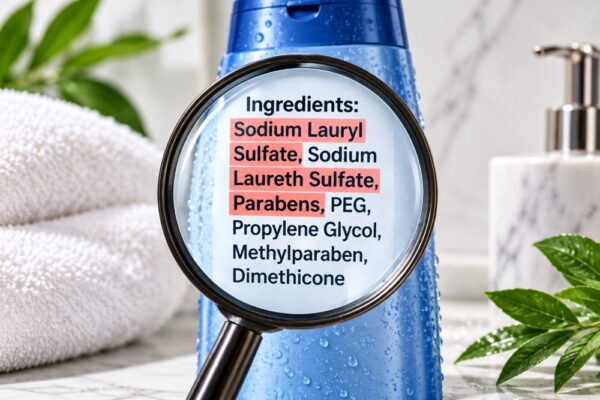
Walk down any beauty aisle, and you’ll see bottles stamped with “Paraben-Free” and “Sulfate-Free.”
For many of us, choosing these products feels like the right thing to do. But if you’ve ever wondered what these chemicals actually do to your skin and body—or whether the hype is real—you aren’t alone.
As a cosmetic formulator, I look at skincare through the lens of human biology. Your skin isn’t just a surface to make shiny; it’s an active, absorbent organ that protects your overall health.
Here is an easy-to-understand look at why parabens and sulfates became so common, why they do more harm than good, and what we use instead to keep your skin calm, healthy, and glowing.
1. Parabens: The Long-Life Preservatives
| Parabens at a Glance | |
| What they are | Synthetic chemical preservatives designed to prevent mould, yeast, and bacterial growth. |
| How to spot them | Any word ending in -paraben (Methylparaben, Propylparaben, Butylparaben, Ethylparaben). |
| Why brands use them | Inexpensive, widely available, and give products a shelf life of several years. |
The Problem: Hormone Disruption and “Chemical Stacking”
Water-based skincare must be preserved—an unpreserved cream can breed dangerous mould, yeast, and bacteria within days. For decades, parabens were the mass-market fix.
The issue is how easily they absorb into the body. Parabens are fat-soluble (lipophilic), meaning they pass right through your skin’s protective lipid barrier and enter your system.
Once inside, laboratory studies show parabens can mimic oestrogen, a key regulatory hormone. While a trace amount in a single cream might seem negligible, consider your daily routine: cleanser, toner, serum, moisturiser, body wash, shampoo, deodorant, sunscreen, and makeup.
This creates “chemical stacking”—a steady buildup of synthetic chemicals across multiple products used every single day. Because of concerns around hormonal balance and long-term wellness, many conscious consumers choose to skip them completely.
The New Zealand Reality
While European regulations and the New Zealand EPA have restricted several long-chain parabens (such as isobutyl- and isopropylparaben), common ones like methyl- and propylparaben are still widely permitted in personal care products. That means the decision to avoid them rests with you and the brands you choose to trust.
2. Sulfates: The “Bubble Trap”
| Sulfates at a Glance | |
| What they are | Industrial-strength chemical detergents (surfactants) designed to cut grease and foam heavily. |
| How to spot them | Sodium Lauryl Sulfate (SLS) or Sodium Laureth Sulfate (SLES). |
| Why brands use them | Inexpensive foaming agents that create the sensory illusion of “deep cleaning.” |
The Problem: Stripping Your Skin Barrier
Sulfates are aggressive degreasers. When you wash your face with a sulfate-heavy wash, the detergent doesn’t know the difference between surface dirt and your skin’s essential protective oils.
Every time you wash with heavy sulfate lather:
It washes away essential lipids: Denatures surface proteins and strips away ceramides, leaving your face tight and squeaky-clean (a warning sign of barrier damage).
It causes moisture loss (TEWL): Water quickly evaporates from the skin cells, causing chronic flaking, dullness, and sensitivity.
It triggers rebound oiliness: A stripped barrier panics and produces extra sebum to protect itself, clogging pores and causing more breakouts.
The Big Myth: “Bubbles Mean Clean”
We’ve all been conditioned by commercials to believe that bigger lather equals a better clean.
In reality, bubbles do not clean your face. Lather is purely cosmetic. High-performance, plant-based cleansers use silky, non-foaming botanical oils that dissolve makeup, sunscreen, and excess sebum using the scientific principle of “like dissolves like”—leaving your skin thoroughly clean, soft, and balanced.
3. What Happens When They Wash Down the Drain?
Your skincare doesn’t disappear when you rinse your face; it washes down the drain and into our waterways and oceans.
Aquatic Ecotoxicity: Research shows that certain synthetic preservatives and harsh surfactants disrupt delicate freshwater and marine ecosystems, contributing to coral reef stress.
Habitat Destruction: Conventional sulfates and thickeners frequently rely on petroleum refining or unsustainably farmed palm oil—a leading driver of tropical deforestation and wildlife habitat loss.
4. The Formulator’s Swap: Smart Green Chemistry
Formulating without parabens and sulfates doesn’t mean your skincare goes bad in a week or fails to clean properly. Modern green chemistry provides gentle, high-performance plant alternatives:
| What to Avoid | Why Skip It | What to Look for Instead | Your Skin’s Reward |
| Sulfates (Foaming agents) | Leaves skin tight, dry, and irritated | Lipid-rich, non-foaming cleansers | Clean, soft skin with zero post-wash tightness |
| Parabens (Preservatives) | Absorbs into the body; hormone health concerns | Benzyl Alcohol, Dehydroacetic Acid | Gentle Ecocert-approved broad-spectrum safety without endocrine risks |
| Synthetic Fragrance | Masks hidden phthalates and irritants | Native NZ plant hydrosols & extracts | Calmer, redness-free skin that smells naturally fresh |
| Palm-Derived Thickeners | Major driver of tropical deforestation | 100% palm-free Brassica alcohols | Silky texture that protects both your barrier and the planet |
At Scenturie, our Natural Creamy Cleanser was created around this exact barrier-first philosophy. It doesn’t foam or bubble; instead, it gently melts away daily grime while flooding your skin with nourishing plant lipids.
Frequently Asked Questions
If a product is paraben-free, how does it stay fresh and safe?
Water-based skincare must be preserved—without protection, mould and bacteria can spoil a product within days. Instead of synthetic parabens, we protect our formulas with an Ecocert-approved blend of Benzyl Alcohol and Dehydroacetic Acid.
This system works in synergy: dehydroacetic acid suppresses the growth and spore germination of moulds and yeasts, while benzyl alcohol acts as a broad-spectrum bactericide. It provides gentle, balanced protection at skin-compatible pH levels (below 6.0)—ensuring your skincare stays fresh and stable without compromising hormonal health.
Why doesn’t my natural cleanser foam up?
Because it is 100% sulfate-free. Natural, barrier-supporting cleansers feel like a silky lotion. Massage it over dry or damp skin, wipe it away with a warm damp cloth, and your face will feel clean and comfortable, never stripped or dry.
Are parabens banned in New Zealand?
Only some of the harshest long-chain types are restricted. Several common parabens remain permitted under local guidelines, which is why checking the ingredient deck on the back of the bottle is so important.
Healthy Skin Doesn’t Need Harsh Chemicals
Clear, radiant skin is not about stripping away natural oils or loading your body with synthetic preservatives. It’s about working in harmony with your skin’s biology.
When you switch to gentle, paraben-free and sulfate-free formulas, your skin stops defending itself against daily irritation. It can finally relax, rebalance, and reveal its natural, healthy radiance.
👉 Ready to make the switch? Explore Scenturie’s 100% Paraben & Sulfate-Free Skincare Range