


In a world full of 10-step skincare routines and trendy gadgets, we often forget the single most effective tool we already own: our own hands.
Alongside formulating plant-based skincare, I still actively practice as a musculoskeletal physiotherapist. In the clinic, hands-on soft-tissue mobilisation is a foundational healing tool. We use manual therapy every single day to release stubborn muscle trigger points, drain inflammation, realign connective tissue, and restore rich, healing blood flow to muscles and joints.
Your face requires that exact same biomechanical care. Beneath the surface sits an intricate network of 43 individual muscles, fascia, and delicate lymphatic vessels that carry the physical weight of daily strain.
Think of your favourite face oil or serum as the nutrient-rich fuel, and facial massage as the manual therapy that activates it. It’s a grounded, non-invasive practice that releases deep holding patterns, lifts sluggish facial contours, and restores healthy cellular vitality.
How Facial Massage Heals, Lifts, and Firms
You don’t need an anatomy degree to understand why this works. Here is what happens under the surface during a focused manual massage:
Wakes Up Your Natural Collagen: Skin cells respond directly to physical touch and load. Gentle, rhythmic tension signals your fibroblasts to produce fresh collagen and elastin, restoring natural bounce and tissue resilience.
Releases Muscle Strain Patterns: We hold immense tension in our faces without noticing—clenching our jaw muscles (masseters) during a demanding workday or furrowing our brows against bright New Zealand sunlight. Releasing these muscles smooths expression lines and prompts your central nervous system to shift into a restorative, healing state.
Manually Flushes Out Puffiness: Your lymphatic system sweeps away metabolic waste and fluid buildup, but unlike your blood, it doesn’t have a central pump like the heart to keep it circulating. Directional strokes guide trapped interstitial fluid away from the lower eyelids and jaw, draining it smoothly down the neck.
Delivers an Instant, Natural Glow: By encouraging surface blood vessels to gently open, massage surges oxygenated blood and essential nutrients directly to your skin cells. The result is a clean, lit-from-within flush you can’t fake with cosmetic highlighters.
Your 2-Minute Daily Facial Massage
Consistency always beats intensity. Committing just 1-2 minutes each evening will create cumulative structural changes in your skin tone.
The Golden Rule: Always Use an Oil
Never massage dry skin. Dry skin creates surface friction, which drags and strains delicate elastin fibres. You need an unrefined plant oil that provides a silky, protective glide while delivering essential fatty acids into your skin barrier.
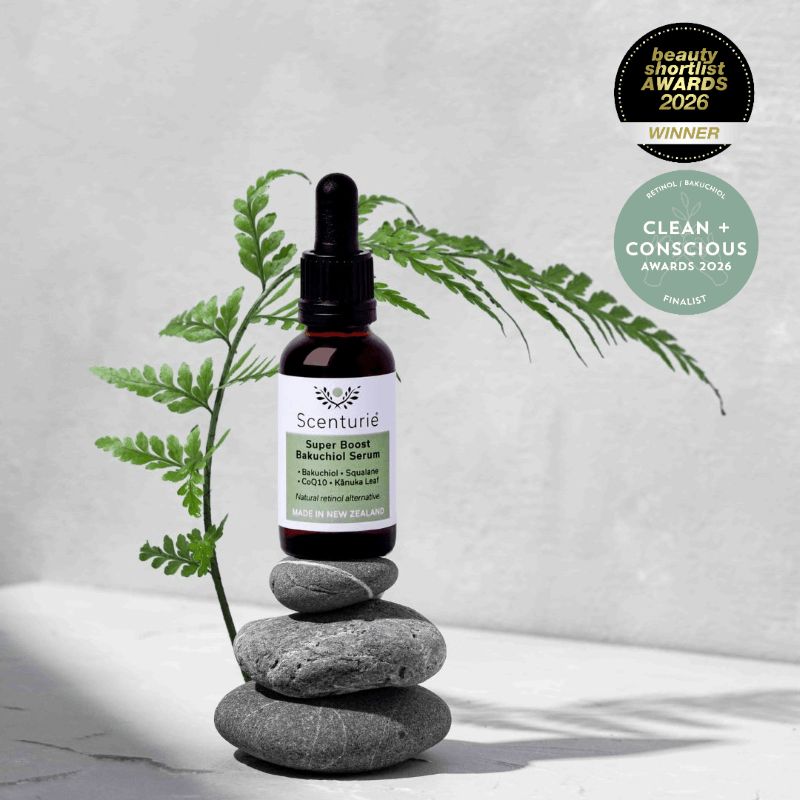
Warm 4-5 drops of Revitalising Face Oil (or Super Boost Bakuchiol Serum) between your palms, press it smoothly over your face and neck, and take a slow, grounding breath.
The 5 Easy Steps
Clear the Neck (The Exit Path): Always start here. Place your flat palms on the sides of your neck and glide gently downward toward your collarbones. Repeat 5 times. In physiotherapy, we always open the outflow channels first so trapped fluid from the face has a clear pathway to drain.
Release the Jaw (Masseter Sculpt): Make loose fists with your hands. Place your chin between your index and middle knuckles, sweeping firmly along your jawbone out toward your earlobes. When you reach the tight muscle knot just in front of your ear, pause and make small, firm circles to melt away jaw-clenching tension. Repeat 6 times.
Lift the Cheeks: Place the fleshy pads of your thumbs under your cheekbones beside your nose. Sweep upward and outward toward your temples with moderate pressure. Repeat 6 times to lift mid-face fluid and boost circulation.
De-Puff the Eyes: Using the soft pad of your ring finger (which exerts the lightest pressure), trace a gentle circle around your orbital bone. Start at the inner corner under the brow, glide outward across the brow bone, and trace featherlight pressure under the eye back to the nose. Repeat 5 times. (For a deeper breakdown of the periorbital anatomy and how to protect fragile 0.5 mm under-eye skin from hollows and shadows, read our journal feature on Do I Need an Eye Cream?)
Smooth the Forehead: Place your flat fingertips on your eyebrows and sweep vertically upward into your hairline. Repeat across your entire forehead to soften brow tension and quiet expressive lines.
Do You Really Need Rollers or Gua Sha Stones?
In short: no. While carved stones and beauty rollers look elegant on a vanity, they are completely unnecessary—and when used improperly, can actually work against your skin.
Your Hands (The Clinician’s Gold Standard): Your hands are an intuitive clinical instrument. Unlike a rigid stone, your fingertips provide real-time tactile feedback, natural biological warmth to melt botanical lipids, and the ability to instantly modulate pressure to match tissue density.
The Danger of Hard Pressure: A common mistake with gua sha is applying too much force. The superficial lymphatic vessels and delicate capillaries sit directly beneath the surface. Firm scraping doesn’t “drain” tissue—it collapses fragile lymph channels, risks broken capillaries, and produces shear friction that stretches delicate elastin. Around the fragile 0.5 mm skin of the eye area, hard stone edges should be avoided entirely.
If You Choose to Use Tools: Reserve gua sha stones strictly for the sturdier musculature along the jawline or neck, always maintain a completely flat angle against the skin with ample oil glide, and leave chilled rollers strictly for broad morning de-puffing across the cheeks.
The Ideal Botanical Pairing
To maximise your results, choose an unrefined, cold-pressed plant oil that supports effortless glide without clogging pores:
For Nourishment & Daily Glow
Scenturie Revitalising Face Oil ($65 NZD, 30mL)
A nutrient-dense blend of cold-pressed Rosehip, Jojoba, and Evening Primrose oils rich in Omegas 3, 6, and 9, potent antioxidants, and natural Vitamin A. It softens rough texture, locks in deep moisture, and restores firm, supple elasticity to leave your complexion smooth and radiant.

For Pro-Ageing & Firmness
Scenturie Super Boost Bakuchiol Serum ($72 NZD, 30mL)
Our award-winning formula featuring 1% pure Bakuchiol, CoQ10, and wild Cacay Oil. The gentle warmth and increased circulation from your massage accelerate the uptake of these fat-soluble actives into your skin.
Slow Down and Enjoy the Ritual
Skincare doesn’t need to be rushed. Taking just five minutes to massage your face at night transforms your routine into a grounding self-care ritual. You’ll head to bed with a relaxed jaw, a quieter mind, and a complexion nourished from the inside out.
Frequently Asked Questions
Q: How often should I do facial massage to see real results?
A: Consistency matters more than duration. Aim for 1 to 2 minutes, 3 to 5 nights per week. An immediate healthy flush and reduced puffiness are visible right away, while structural benefits—such as improved muscle tone, softened expression tension, and firmer skin—typically develop over a consistent 4- to 6-week cycle as cellular turnover and collagen synthesis take place.
Q: Can facial massage cause breakouts or clog pores?
A: Not if you use the right medium. Breakouts occur when people massage with comedogenic mineral oils, synthetic silicones, or heavy waxes that trap dirt inside pores. Using a light, biocompatible botanical oil high in linoleic acid—such as Scenturie Revitalising Face Oil—nourishes the barrier without occluding pores. Always ensure your hands and face are clean before you begin.
Q: Should I massage my face in the morning or at night?
A: Both offer distinct physiological benefits:
Morning massage: Focuses on lymphatic drainage to flush out overnight fluid retention, de-puff the eyes, and wake up sluggish morning circulation.
Evening massage: Ideal for myofascial release—melting away jaw clenching, brow tension, and daily postural strain while helping fat-soluble night actives absorb thoroughly.
Q: Can I do facial massage if I have active acne or rosacea?
A: Yes, but you must modify your technique. Never apply friction, firm pressure, or dragging motions over active, inflamed blemishes or rosacea flare-ups, as this can spread surface bacteria or exacerbate vascular flushing. Instead, focus entirely on light, downward lymphatic drainage strokes down the sides of the neck and gentle featherlight pumping around the clavicles. This helps clear systemic inflammation away from the facial tissue without irritating the skin surface.
Q: Will pulling or massaging my skin cause it to sag or stretch?
A: Only if you make the mistake of massaging bare, dry skin. Dry friction produces shear stress, which can strain delicate superficial elastin fibres. As long as you apply 4 to 5 drops of facial oil to create effortless slip and always work in upward, outward, and anatomically supportive directions, massage strengthens tissue tone rather than stretching it.
Q: Can I use a moisturiser or day cream instead of an oil for massage?
A: Moisturisers and day creams are formulated with water-phase humectants that absorb quickly into the epidermis. Within 30 to 60 seconds, the slip disappears, leading to skin tugging. A cold-pressed facial oil provides sustained glide for a full 5-minute routine while sealing moisture into the stratum corneum.
Q: Is facial massage safe if I have had Botox or dermal fillers?
A: If you have recently had cosmetic injectables, wait at least 2 to 3 weeks (or consult your cosmetic injector) before performing any manual facial massage to prevent displacing product. Once settled, gentle massage can help maintain healthy circulation and tissue quality in the untreated surrounding muscles.