
Updated: September 2026
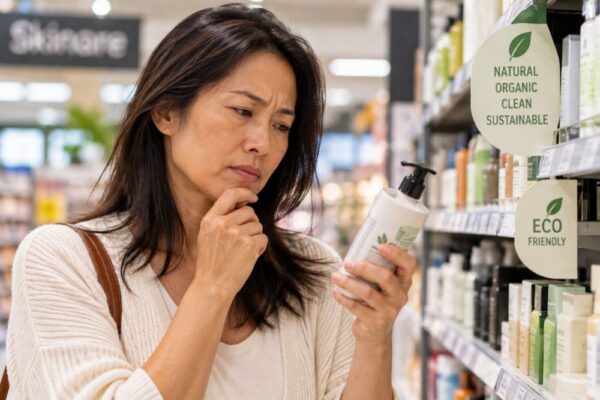
You’re standing in the beauty aisle, holding a moisturiser in a lovely cardboard box with flowers and leaves on it.
The front label displays everything designed to put your conscious mind at ease: “Clean.” “Plant-Powered.” “Eco-Conscious.” “Pure & Natural.”
Yet a quiet voice in the back of your mind asks: “Is it really… or am I just being sold a story?”
If you’ve ever felt that skepticism, trust your instincts. Today’s beauty aisles are saturated with clever marketing designed to tap into our desire for healthier skin and a cleaner planet. But behind the serene botanical imagery, many products still rely on cheap synthetic fillers, hidden irritants, and single-use plastic containers that end up in landfills.
This practice is called greenwashing—and in the cosmetic industry, it is remarkably easy for brands to get away with.
As a natural cosmetic formulator, I look past the front label and go straight to the ingredient list and lifecycle design. Here is how greenwashing really works, how to read an INCI list like a chemist, and the three questions that will instantly separate genuine eco-ethics from marketing spin.
The Legal Loophole Behind “Natural” Beauty
Here is an uncomfortable truth about cosmetic regulations: words like “clean,” “green,” “natural,” and “eco-friendly” have no legal definition.
A brand can formulate a cream that is 99% petroleum-derived mineral oil, synthetic emulsifiers, and silicones, add two drops of lavender oil at a 0.05% concentration, and legally slap the words “Infused with Pure Botanicals” across the front of the jar.
Front of the Box (Marketing)             Back of the Box (Reality)
┌──────────────────────────────┐        ┌──────────────────────────────┐
│  "Eco-Pure Natural Glow"     │        │ Water, Dimethicone,          │
│  🌿 With Organic Botanicals  │  ──►   │ Mineral Oil, Fragrance,      │
│  Dermatologist Tested        │        │ Phenoxyethanol, [Botanical   │
└──────────────────────────────┘        │ Extract at 0.01%]            │
                                        └──────────────────────────────┘
Because regulatory bodies do not police broad eco-adjectives on cosmetic labels, the burden of proof falls entirely on the shopper.
3 Red Flags That Reveal a Greenwashed Product
When evaluating a brand, skip the front-panel claims and look for these three industry shortcuts:
1. The “Fragrance / Parfum” Catch-All (And the Naticide Exception)
On conventional labels, the word “Fragrance” or “Parfum” is often an umbrella loophole hiding hundreds of synthetic petrochemicals and phthalates.
However, cosmetic labelling laws (INCI) also require certain natural plant extracts to be listed as Parfum. A prime example is Naticide—a 100% plant-derived antimicrobial sourced from vanilla and almond isolates.
Rather than scenting a product, formulators use Naticide as a safe, natural secondary preservative to protect water-based formulas from mould and bacteria without harsh parabens or phenoxyethanol.
The rule of thumb: An authentic brand explicitly clarifies that any Parfum on its deck is 100% plant-derived (like Naticide), rather than artificial synthetic perfume.
2. “Angel Dusting” Active Botanicals
“Angel dusting” is an industry term for adding a tiny, negligible sprinkle of a trendy natural extract (like Rosehip, Kakadu Plum, or Harakeke) solely to feature it on the advertising campaign.
In cosmetic labelling (INCI regulations), ingredients are listed in descending order of concentration down to the 1% line. If the celebrated “hero botanical” appears below preservatives like phenoxyethanol or potassium sorbate, it is present at less than 1%—doing virtually nothing for your skin.
3. The Curbside Plastic Illusion
Perhaps the most widespread greenwashing trick is claiming a product is “sustainable” simply because its plastic pump bottle is “100% recyclable.”
In reality, the global beauty industry generates more than 120 billion units of packaging every year, the vast majority of which is virgin plastic. Worse still, multi-part plastic pumps, droppers, and tinted plastics are rarely processed by municipal recycling plants—meaning most end up incinerated or in landfill. True environmental responsibility requires eliminating single-use plastic entirely through circular materials and closed-loop systems.
The Formulator’s 3-Point Authenticity Checklist
To cut through the noise, ask these three non-negotiable questions of any skincare brand:
           Is the Skincare Brand Genuinely Conscious?
                               │
       ┌───────────────────────┼───────────────────────┐
       ▼                       ▼                       ▼
1. Full Transparency    2. Closed-Loop Design    3. Ethical Sourcing
  No hidden "fragrance"    Infinitely recyclable    Fair-trade & regenerative
  or filler silicones.     glass, refills, loops.   botanical supply chains.
1. Do they show you everything in the bottle—and what’s left out?
A transparent brand does not hide behind jargon. Look for a full, unedited ingredient list on every product page. Their “free-from” standard should be unwavering: zero sulfates, parabens, phthalates, silicones, synthetic dyes, or artificial fragrances.
2. What happens to the packaging when you finish it?
Does the brand provide a realistic afterlife for its containers? Look for:
Infinitely recyclable materials: Amber glass and aluminium (which can be melted down and repurposed endlessly without degradation, unlike plastic).
Plastic-free refill options: Allowing you to reuse your primary dispensers.
A verifiable circular return programme: Where empties are physically collected, washed, sterilised, and refilled.
3. Can you trace the human beings and origins behind the ingredients?
Is the company operated by a faceless holding conglomerate, or by real formulators who know their suppliers? Look for brands that build direct partnerships—such as sourcing Fair Trade Shea Butter directly from women’s cooperatives, or working with ethical wild-harvesters who protect native ecosystems.
How Scenturie Sets the Circular Standard
At Scenturie, we believe you should never have to compromise your skin’s health or your environmental values.
Complete Formulation Transparency: Every single ingredient we use serves a biological purpose for your skin barrier. We use 100% plant-powered, bio-identical actives—from native New Zealand Harakeke, Mānuka, and upcycled Grape Seed oil to botanical Bakuchiol. We are completely free from synthetic fragrances, fillers, and mineral oils.
Plastic-Free & Refillable Packaging: We bottle our formulas in protective amber glass to shield delicate plant antioxidants from UV light without plastic leaching. When you reorder, our aluminium refill caps allow you to reuse your treatment pumps and droppers over and over.
The Scenturie Loop: We don’t leave recycling to municipal guesswork. Through The Scenturie Loop, our nationwide closed-loop return scheme, our customers return empty glass jars and bottles to us via post or local community partners (like Howick House Pharmacy). If they are in excellent condition, we professionally clean, sterilise, and refill them, keeping materials in perpetual use.
Ethical, Direct Sourcing: From certified Fair Trade unrefined Shea Butter hand-harvested by a women’s cooperative in Ghana, to sustainably sourced native NZ botanicals, our ingredients are chosen to respect both community livelihoods and the land.
Independently Validated: In 2026, Scenturie’s clean, low-waste formulations earned 15 global honours at the International Beauty Shortlist Awards, including Best Plastic-Free Body Product.
Stop Guessing, Start Nourishing
You shouldn’t need a degree in biochemistry to know whether your moisturiser is doing good or doing harm. When a brand respects your intelligence, it shows in every drop of the formula and every detail of the bottle.
Choose skincare built on real science, circular sustainability, and total transparency.
👉 Discover the Difference: Explore Scenturie’s Award-Winning, Plastic-Free Skincare Rituals